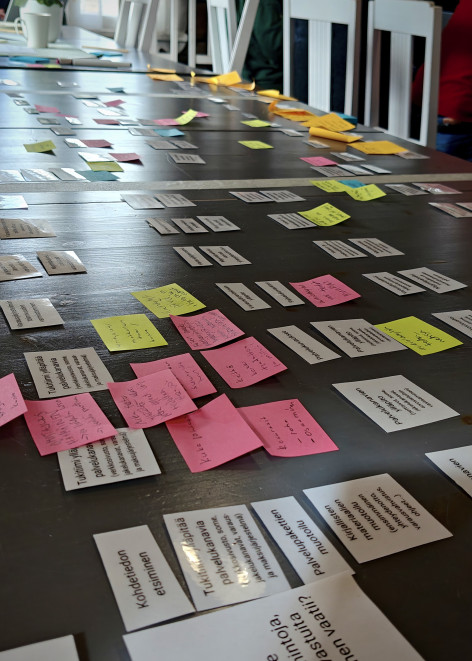
In April 2026, Lapland Scientific Tourism project organized three workshops for companies and destinations in Rovaniemi, Levi, and Salla.
The participants of the workshops were from tourism companies and municipalities. Some of the participants had already developed their product with a stronger science base, but others were new to the idea.
Lapland Scientific Tourism project continues the work of the earlier Scientific Tourism project (2020–2022), which developed the WONDER SEEKERS concept. Running from August 2025 to July 2026, the current project explores the opportunities and challenges related to developing science tourism among tourism companies in Finnish Lapland.
Themed ideas
During the workshops, service design was used to map possibilities and challenges, as well as ideas related to science tourism. The ideas can be themed into nine groups:
- Core concept: science → experience → meaning
- Experiences where scientific knowledge helps visitors better understand nature, local environments, and their own relationship with them.
- Nature, ecosystems, and citizen science
- Guided excursions where visitors collect observations or environmental data as part of citizen science activities.
- Sky, light, and Arctic phenomena
- Northern lights and astronomy tours that combine storytelling with atmospheric and space science.
- Well-being, health, and biohacking
- Nature-based wellness experiences supported by biometric measurements, sleep research, or recovery data.
- Culture, history, and local life
- Experiences combining local history, livelihoods, and cultural knowledge with scientific perspectives.
- Courses, camps, and deep learning
- Longer immersive programs such as survival courses, science camps, or “a week as a researcher” concepts.
- Routes, products, and experiences
- Thematic hiking routes focused on geology, ecosystems, or Arctic history.
- Digitalization and gamification
- Interactive science trails, apps, and gamified learning experiences using real-world environmental data.
- Science centers and infrastructure
- Ideas related to interactive exhibitions, research station visits, and science-focused visitor centers.
What could science tourism look like in practice?
The workshop discussions highlighted several recurring themes and development directions for science tourism in Lapland. While the ideas varied from small-scale additions to existing tourism products to more immersive learning experiences, many of them shared a common goal: combining scientific knowledge, meaningful experiences, and stronger connections to Arctic nature and local environments.
1. From passive sightseeing to participatory learning
Many ideas focused on moving visitors from passive observation towards active participation and learning. Participants discussed different forms of citizen science, where tourists could contribute to biodiversity observations, environmental monitoring, invasive species mapping, or animal tracking during excursions. The aim was not only to offer information, but to involve visitors more directly in understanding Arctic nature and environmental change.
2. Combining well-being tourism with measurable science
Another recurring theme was the connection between nature, health, and measurable well-being. Participants explored ideas such as forest bathing experiences supported by before-and-after stress or recovery measurements, sleep and darkness tourism, and experiences connected to circadian rhythms, cold exposure, and recovery. Some discussions also touched on the possibility of using wearable technology and biometric data as part of tourism experiences.
3. Making Arctic phenomena more understandable
The workshops highlighted strong interest in experiences related to northern lights, astronomy, seasonal light conditions, and atmospheric phenomena. Rather than focusing only on visual experiences, participants discussed how scientific interpretation could help visitors better understand the Arctic environment. Ideas included astronomy excursions, northern lights tours with atmospheric science content, and themed routes focused on sky and light phenomena.
4. Creating longer and deeper experiences
Many ideas also emphasized immersion and deeper engagement instead of short standalone activities. Participants discussed science camps, survival courses, “week as a researcher” concepts, and thematic hiking routes connected to geology, ecosystems, or local history. These concepts aimed to combine tourism, learning, and hands-on experiences in more meaningful and memorable ways.
What’s next?
The workshops demonstrated that interest in science tourism already exists across Lapland, but long-term development requires stronger cooperation between researchers, tourism companies, and destinations. One important next step could be creating practical ways to share scientific knowledge between these groups and transform research into accessible visitor experiences. While the current project has reached its goal in creating a network and mapping possibilities for science tourism in Lapland, this could be a task for another science tourism development project.